Algorithms of Automated Resume Tailoring: Under the Hood of RAG-Based Customization
A deep technical dive into RAG (Retrieval-Augmented Generation) architectures for hyper-personalizing resumes. Learn how AI aligns candidate experiences with job requirements without hallucinating facts.
Dmitry Freeman
HR-Tech Architect & ATS Integration Specialist
Dmitry Freeman is an HR-Tech platform engineer and career optimization consultant. He focuses on RAG-driven CV tailoring, ATS matching algorithms, automated application pipeline engineering, and technical interview simulation tech.
Recruiters at leading tech companies spend an average of 6 to 8 seconds skimming a resume before making a decision. If they don’t spot key technologies or experiences addressing their immediate pain points within that window, the resume is instantly archived.
Because every vacancy is unique, submitting a single generic CV to dozens of different roles yields low conversion rates. On the other hand, manually modifying your resume to fit every single job description takes hours of tedious rewriting.
This is where AI Resume Tailoring algorithms come into play. Modern Large Language Models (LLMs) allow systems to semantically align a job description with a candidate’s background, rearranging and highlighting key experiences “on the fly” with zero manual intervention.
In this article, we will examine the mathematics and algorithms powering professional resume tailoring systems, design a RAG (Retrieval-Augmented Generation) pipeline for career data, and build an automated fact-checking validator in Python.
1. Designing a RAG Architecture for Resume Data
A naive approach to automated tailoring passes your entire resume and the job description to an LLM, asking it to rewrite the text. However, without strict formatting constraints, models frequently hallucinate, inventing fake technologies or exaggerating past achievements.
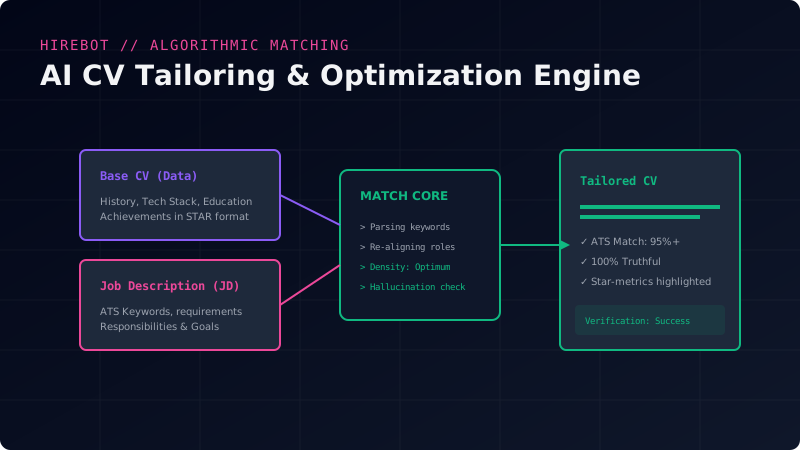
To ensure deterministic, factual results, we must decompose career data into atomic experience chunks and build a Retrieval-Augmented Generation (RAG) pipeline.
[Job Description (JD)] ──► [Entity & Tech Requirement Extraction]
                                     │
                                     ▼
[Master Experience Base] ──► [Semantic Vector Search (Qdrant)]
                                     │
                                     ▼
                               [Chunk Ranking] ──► [LLM Generator] ──► [Tailored Resume PDF]
The RAG Pipeline Workflow:
- Decomposing Experience Chunks: Instead of a single static text file, your work history is stored as a structured collection of achievements, projects (modeled in STAR format), and tech stacks.
- Analyzing Job Requirements: The algorithm extracts core entities from the Job Description: tech stacks, soft skills, desired metrics, and target responsibilities.
- Semantic Query & Ranking: Vector search (using distance metrics) retrieves projects from your history that match the extracted requirements.
- Context-Constrained Generation: The LLM receives only the retrieved projects as its ground-truth context. It translates and highlights these experiences using the employer’s specific terminology. Irrelevant details are summarized or temporarily hidden to avoid diluting the recruiter’s focus.
2. Semantic Mapping and Reranking Algorithms
To assess how well your past projects match a given job description’s demands, we leverage a Cross-Attention similarity mapping pipeline based on Transformer-style embeddings.
We compute the Cosine Similarity between a job requirement vector ($V_i$) and an experience chunk vector ($C_j$) using the formula:
Cosine_Similarity(V, C) = (V · C) / (||V|| * ||C||)If the semantic similarity passes a predefined threshold (e.g., 0.72), the project is prioritized for page-one visibility in the tailored output.
3. Protecting Truth: Python Implementation of Hallucination Guardrails
The most critical step of automated resume tailoring is ensuring absolute factual integrity. We must verify that the generator has not introduced unauthorized technologies or inflated key metrics (e.g., turning “improved load times by 5%” into “improved by 50%”).
We will build a Python audit utility that utilizes set comparisons and regular expression matchers to validate generated output against the master resume.
import re

def extract_numbers(text):
    """
    Extracts numerical metrics and percentages to prevent metrics falsification.
    """
    # Captures formats like 10, 45%, 1.2M, $500k
    return set(re.findall(r'\b\d+(?:\.\d+)?%?|(?:\$\d+(?:k|M)?)\b', text.lower()))

def extract_hard_skills(text, skill_dictionary):
    """
    Extracts technologies found in text based on a hard skills database.
    """
    found_skills = set()
    for skill in skill_dictionary:
        # Word boundaries prevent false positives (e.g., matching 'go' in 'google')
        pattern = r'\b' + re.escape(skill.lower()) + r'\b'
        if re.search(pattern, text.lower()):
            found_skills.add(skill.lower())
    return found_skills

def verify_tailored_resume(original_cv, tailored_cv, allowed_skills):
    print("[*] Initiating resume factual verification audit...")

    # 1. Audit quantitative metrics
    original_numbers = extract_numbers(original_cv)
    tailored_numbers = extract_numbers(tailored_cv)

    # Tailored copy must not contain any new, unverified numbers
    fake_numbers = tailored_numbers - original_numbers

    # 2. Audit technology stack
    original_skills = extract_hard_skills(original_cv, allowed_skills)
    tailored_skills = extract_hard_skills(tailored_cv, allowed_skills)

    # Identify skills added by the generator that were not in the master copy
    fake_skills = tailored_skills - original_skills

    is_valid = True

    if fake_numbers:
        print(f"[CRITICAL] Hallucinated metrics or numbers detected: {fake_numbers}")
        is_valid = False
    else:
        print("[+] Numerical metrics audit: PASSED (no metric inflation detected)")

    if fake_skills:
        print(f"[CRITICAL] Hallucinated technologies detected: {fake_skills}")
        is_valid = False
    else:
        print("[+] Hard skills stack audit: PASSED (no skill injection detected)")

    return is_valid

# Demonstration run
if __name__ == "__main__":
    # Allowed skill lexicon
    known_skills = ["Python", "Go", "Kubernetes", "Docker", "Terraform", "PostgreSQL", "React", "AWS"]

    original_text = """
    Developed backend APIs in Python and PostgreSQL. Improved request response speeds by 15%.
    Utilized Docker for environment containerization.
    """

    # Example of a hallucinating generator (injects Kubernetes and inflates metric to 50%)
    bad_ai_generated_text = """
    Designed high-performance backend APIs using Python, PostgreSQL, and Kubernetes in AWS.
    Optimized queries, increasing transaction response speeds by 50%.
    """

    verify_tailored_resume(original_text, bad_ai_generated_text, known_skills)
4. Designing a Healthy Human-in-the-Loop Workflow
To maintain absolute credibility, AI should serve only as an interactive assistant, keeping the human candidate as the authoritative editor.
A secure, hybrid workflow looks like this:
- Curate a Master CV: Maintain an exhaustive 3-to-5 page master CV detailing every project, technology, and metric from your history. This is your local source of truth.
- Automated Vector Matching: The RAG system reads the job description, pulls the most relevant items from your master document, and templates a targeted 1-to-2 page draft.
- Fina Review & Render: The candidate performs a quick manual check of the generated Markdown file, makes final structural polishes, and compiles it to PDF using a clean Astro rendering engine.
Conclusion
Resume tailoring engineering is not about cheating the system, but rather about learning to present your background in a format that parsing systems and hiring managers can easily digest. By implementing highly constrained RAG architectures and automated validation engines, candidates can scale their job search with absolute precision, accuracy, and professional integrity.
Try the free AI CV Analyzer — score your resume against real ATS criteria and see keyword gaps in seconds.
Need to check your own CV?
Get instant AI-powered analysis of your resume. Free, no account needed.
Try AI CV Analyzer →Related Posts
The Mathematics of ATS Grading and Scoring Algorithms
Behind the curtain of Applicant Tracking Systems: TF-IDF formulations, entity recognition, and parsing heuristics that make or break candidate rankings.
Resume ATS Compatibility Engineering: Under the Hood of Parsing Engines
A deep technical breakdown of how modern Applicant Tracking Systems (ATS) work. Discover how algorithms tokenize PDFs, calculate keyword weights (TF-IDF), and why beautiful multi-column designs destroy your parse rates.
Rate-Limiting and Circuit-Breaking Distributed Web Scrapers
Advanced scraping architecture: setting up Redis-Sentinel limits, rotating residential proxy pools, and bypass strategies for robust, concurrent job parsing.
Optimizing Vector Embeddings for Semantic Job-Candidate Alignment
A comprehensive study on matching engineering vacancies to candidate CVs using specialized sentence transformers, cosine similarity matrices, and Qdrant namespaces.
Mitigating Demurrage and Credit Decay in Distributed Hiring Platforms
An economic and technical analysis of priority-driven credit models, token demurrage, and anti-abuse systems in peer-to-peer job search backends.
On this page
Category
careersRelated Posts
The Mathematics of ATS Grading and Scoring Algorithms
Behind the curtain of Applicant Tracking Systems: TF-IDF formulations, entity recognition, and parsing heuristics that make or break candidate rankings.
Resume ATS Compatibility Engineering: Under the Hood of Parsing Engines
A deep technical breakdown of how modern Applicant Tracking Systems (ATS) work. Discover how algorithms tokenize PDFs, calculate keyword weights (TF-IDF), and why beautiful multi-column designs destroy your parse rates.
Rate-Limiting and Circuit-Breaking Distributed Web Scrapers
Advanced scraping architecture: setting up Redis-Sentinel limits, rotating residential proxy pools, and bypass strategies for robust, concurrent job parsing.
Optimizing Vector Embeddings for Semantic Job-Candidate Alignment
A comprehensive study on matching engineering vacancies to candidate CVs using specialized sentence transformers, cosine similarity matrices, and Qdrant namespaces.
Mitigating Demurrage and Credit Decay in Distributed Hiring Platforms
An economic and technical analysis of priority-driven credit models, token demurrage, and anti-abuse systems in peer-to-peer job search backends.